Thursday, February 2, 2012

BOW 1 (Transcription,Translation and Protein Synthesis)

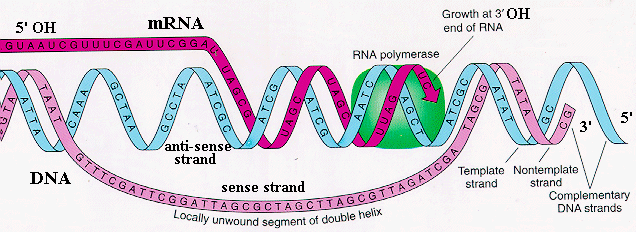
http://www.scientificpsychic.com/fitness/transcription.gifTRANSCRIPTION: During the process of transcription, the DNA begins to split in both left and right directions.  Then the promoters attach themselves to it.  After being attached, the promoters initiate RNA synthesis and makes a complement. This meaning the that the RNA synthesis begins.  The next step includes that the RNA synthesis stops.  Finally, the DNA zips back up.

http://0.tqn.com/d/chemistry/1/0/G/m/mrnatranslation.jpgTRANSLATION:After the process of transcription, comes the process of translation.  First, the tRNA receive the amino acids (AUG0.  Then, the amino acid by methniodine  is coded by AUG.  The tRNA changes into mRNA and attaches to ribosomes.  tRNA then attaches to ribosomes and mRNA while the amino acids get connected to the chain.  Finally, it reaches to UAU (Copy to anticodon)

http://www.accessexcellence.org/RC/VL/GG/images/protein_synthesis.gif
PROTEIN SYNTHESIS:During the protein synthesis, the amino acids are connected to form peptides.  Later on they disconnect from the mRNA.  The polypeptide can either then form into sheets or a helix.  Both the sheets and helix shape fold to create proteins .

BLAST Gene WS

ELN elastin [ Homo sapiens ](Gene 2)

Gene ID: 2006, updated on 22-Jan-2012

Summary


Official Symbol
ELNprovided by HGNC
Official Full Name
elastinprovided by HGNC
Primary source
HGNC:3327
See related
Ensembl:ENSG00000049540; HPRD:00556; MIM:130160; Vega:OTTHUMG00000150229
Gene type
protein coding
RefSeq status
REVIEWED
Organism
Homo sapiens
Lineage
Eukaryota; Metazoa; Chordata; Craniata; Vertebrata; Euteleostomi; Mammalia; Eutheria; Euarchontoglires; Primates; Haplorrhini; Catarrhini; Hominidae; Homo
Also known as
WS; WBS; SVAS
Summary
This gene encodes a protein that is one of the two components of elastic fibers. The encoded protein is rich in hydrophobic amino acids such as glycine and proline, which form mobile hydrophobic regions bounded by crosslinks between lysine residues. Deletions and mutations in this gene are associated with supravalvular aortic stenosis (SVAS) and autosomal dominant cutis laxa. Multiple transcript variants encoding different isoforms have been found for this gene. [provided by RefSeq, Jul 2008]
 

PSEN2 presenilin 2 (Alzheimer disease 4) [ Homo sapiens ](Gene 3)

Gene ID: 5664, updated on 21-Jan-2012

Summary

Official Symbol
PSEN2provided by HGNC
Official Full Name
presenilin 2 (Alzheimer disease 4)provided by HGNC
Primary source
HGNC:9509
See related
Ensembl:ENSG00000143801; HPRD:02860; MIM:600759; Vega:OTTHUMG00000037563
Gene type
protein coding
RefSeq status
REVIEWED
Organism
Homo sapiens
Lineage
Eukaryota; Metazoa; Chordata; Craniata; Vertebrata; Euteleostomi; Mammalia; Eutheria; Euarchontoglires; Primates; Haplorrhini; Catarrhini; Hominidae; Homo
Also known as
AD4; PS2; AD3L; STM2; CMD1V
Summary
Alzheimer's disease (AD) patients with an inherited form of the disease carry mutations in the presenilin proteins (PSEN1 or PSEN2) or the amyloid precursor protein (APP). These disease-linked mutations result in increased production of the longer form of amyloid-beta (main component of amyloid deposits found in AD brains). Presenilins are postulated to regulate APP processing through their effects on gamma-secretase, an enzyme that cleaves APP. Also, it is thought that the presenilins are involved in the cleavage of the Notch receptor such that, they either directly regulate gamma-secretase activity, or themselves act are protease enzymes. Two alternatively spliced transcript variants encoding different isoforms of PSEN2 have been identified. [provided by RefSeq, Jul 2008]
 

FBN1 fibrillin 1 [ Homo sapiens ](Gene 5)

Gene ID: 2200, updated on 29-Jan-2012

Summary

Official Symbol
FBN1provided by HGNC
Official Full Name
fibrillin 1provided by HGNC
Primary source
HGNC:3603
See related
Ensembl:ENSG00000166147; HPRD:00618; MIM:134797; Vega:OTTHUMG00000172218
Gene type
protein coding
RefSeq status
REVIEWED
Organism
Homo sapiens
Lineage
Eukaryota; Metazoa; Chordata; Craniata; Vertebrata; Euteleostomi; Mammalia; Eutheria; Euarchontoglires; Primates; Haplorrhini; Catarrhini; Hominidae; Homo
Also known as
FBN; SGS; WMS; MASS; MFS1; OCTD; SSKS; WMS2; ACMICD; GPHYSD2
Summary
This gene encodes a member of the fibrillin family. The encoded protein is a large, extracellular matrix glycoprotein that serve as a structural component of 10-12 nm calcium-binding microfibrils. These microfibrils provide force bearing structural support in elastic and nonelastic connective tissue throughout the body. Mutations in this gene are associated with Marfan syndrome, isolated ectopia lentis, autosomal dominant Weill-Marchesani syndrome, MASS syndrome, and Shprintzen-Goldberg craniosynostosis syndrome. [provided by RefSeq, Jul 2008]
 

RB1 retinoblastoma 1 [ Homo sapiens ](Gene 6)

Gene ID: 5925, updated on 29-Jan-2012

Summary

Official Symbol
RB1provided by HGNC
Official Full Name
retinoblastoma 1provided by HGNC
Primary source
HGNC:9884
Locus tag
RP11-174I10.1
See related
Ensembl:ENSG00000139687; HPRD:01574; MIM:614041; Vega:OTTHUMG00000016900
Gene type
protein coding
RefSeq status
REVIEWED
Organism
Homo sapiens
Lineage
Eukaryota; Metazoa; Chordata; Craniata; Vertebrata; Euteleostomi; Mammalia; Eutheria; Euarchontoglires; Primates; Haplorrhini; Catarrhini; Hominidae; Homo
Also known as
RB; pRb; OSRC; pp110; p105-Rb
Summary
The protein encoded by this gene is a negative regulator of the cell cycle and was the first tumor suppressor gene found. The encoded protein also stabilizes constitutive heterochromatin to maintain the overall chromatin structure. The active, hypophosphorylated form of the protein binds transcription factor E2F1. Defects in this gene are a cause of childhood cancer retinoblastoma (RB), bladder cancer, and osteogenic sarcoma. [provided by RefSeq, Jul 2008]


Saturday, January 21, 2012

Osmosis Jones

http://images.zap2it.com/images/movie-28168/osmosis-jones-4.jpg
The three differences that the movie Osmosis Jones is like our system is that when our body is attacked because of germs, our body sends white blood cells to get rid of them.  Our body begin with simple symptoms that later on develops into more serious ones.  Also, our body tries to prevent bacteria from entering our body.  The movie is unlike our immune system because we do not have actual diseases that are left unprotected until it gets very serious.  Our body works in different function with the way on how Jones tries to stop the Red Death by actually fighting it in Shane's eye.  Also, our body responds immediately and takes full action when a disease occurs

Dominanat/Recessive Genes

A dominant gene is a gene that is more likely to be shown through the offspring.  A recessive gene is the gene,that when compared to the dominant, is less like likely to appear in an offspring.

Example: A couple decide to have a child.  The father is tall in height (TT) and the mother is not (tt).  This means that the domimant trait would be having the height be tall while the recessive would not.

Dangeros Virus

If I were in charge of protecting the Us from a deadly virus, I would try to figure out the main source of the deadly disease and destroy what is causing it.  Then, the people tat were infected were to be kept away from the uninfected people until they are treated or a cure was to be discovered.  By doing this, it protects the uninfected people from getting the disease and having it spread to healthy people.  If killing the main source of the disease, meaning where it started, that it would prevent the disease to continually spread about.

Sunday, January 8, 2012

Benefits of Fungi

http://ic2.pbase.com/g5/99/524399/3/105983106.vIdiKKP9.jpgFungi decompose dead materials and return them as nutrients to the soil to help plants grow.  They also play an important role in curing diseases.  For example, the penicillin helped identify antibiotics.  Fermentation is the process in which the fungi help break down organic matter.  Lastly, some fungi, like certain mushrooms, work as food for people. (http://www.ehow.com/list_6064495_effects-fungus.html)

Sugar from Chlorophyll

http://www.celsias.com/media/uploads/admin/photosynthesis-color.jpg
Plants make sugars from chlorophyll.  Plants produce sugars in the process of photosynthesis.  The chloroplasts capture energy from the sun with the help from the chlorophyll.  With this the plant converts the sun"s energy, the water and the carbon dioxide to create glucose (sugars) and oxygen (http://www.sucrose.com/learn.html).